Serve the referral partner first.
Agents, brokers and lenders drive repeat volume. Giving them a dedicated path, a direct contact and a straightforward way to refer a file is the highest-return decision on the site.
Your best client is not the buyer. It is the agent who sends you nine closings a year, and most firm websites give them nothing at all.
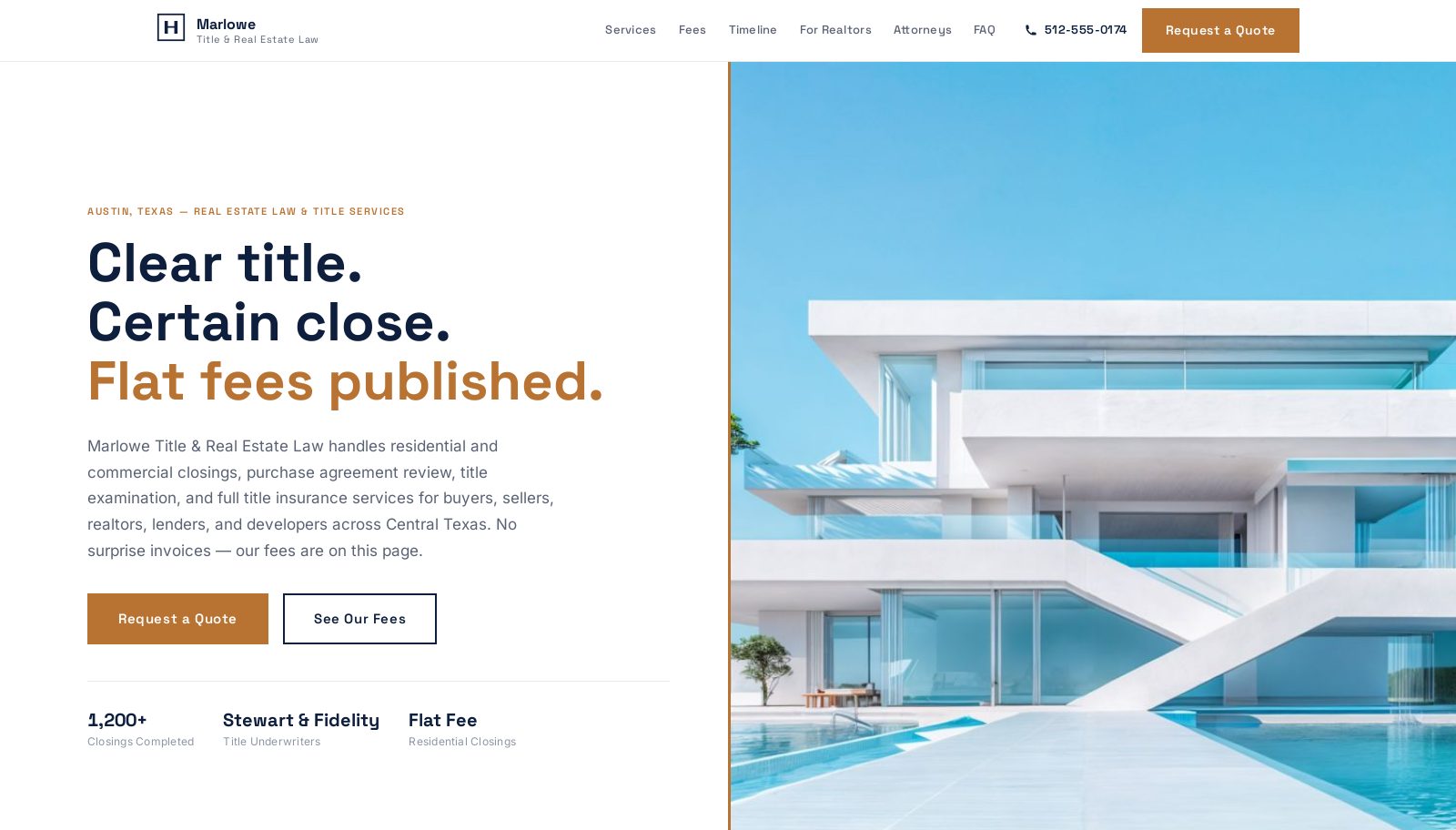
Real estate websites from LawFirmWebAgency are built around the two audiences that actually drive the practice: buyers and sellers who need a closing handled, and the agents, brokers and lenders who send repeat referrals. The site publishes flat fees, gives referral partners a dedicated path, and treats transaction speed as the primary selling point.
Real builds we can adapt for your firm. Open any of them to see the fee presentation and the referral partner paths.
This is a volume practice built on repeat referral relationships, which makes it the one area where the most valuable visitor is not the client.
Agents, brokers and lenders drive repeat volume. Giving them a dedicated path, a direct contact and a straightforward way to refer a file is the highest-return decision on the site.
Residential closings are shopped on price and turnaround. Firms that publish a flat fee win the enquiry from firms that make people call to ask.
Everyone in a transaction is anxious about the closing date. Clear turnaround commitments and status visibility beat any amount of credential copy.
A first-time buyer and a developer negotiating a ground lease are unrelated buyers. Merging them makes the site read as generic to both.
Every element is chosen to increase either closings handled or referral relationships held.
A section built for agents, brokers and lenders with direct contact details, a simple file referral form, turnaround commitments and co-brandable material they can pass to their own clients.
Residential closing fees stated plainly, with what is and is not included. This is a price-shopped service and publishing the number is the single strongest conversion lever available.
Residential purchase and sale, refinance, title review and title insurance, commercial acquisition and disposition, leasing, 1031 exchange, land use and zoning, easements and boundary disputes, landlord and tenant, and foreclosure defense.
Typical time from engagement to closing, review turnaround on a contract, and how quickly you respond. Certainty about the date is what the whole transaction runs on.
What happens between contract and closing, what the attorney handles, and what the client needs to prepare. Ranks well, reduces inbound questions, and gets cited by answer engines.
Secure upload for contracts and disclosures, and a clear route for signing. Most transaction friction is document friction, and the site should remove it rather than add to it.
A real estate law firm website should split residential from commercial work and give agents and lenders their own route in. These are the pages most real estate law sites need:
Why one page per matter works is covered in our guide to practice area pages that rank. Every page above is included in our law firm web design service.
Real estate practices run on referrals and published fees, and both are regulated. Three rules matter most on a real estate law website.
An advertised closing fee that leaves out common charges can mislead under ABA Model Rule 7.1, so list what the fee includes and what is billed separately.
Model Rule 7.2(b) bars paying for referrals, allowing only reciprocal arrangements that are not exclusive and are disclosed to the client.
Section 8 of the Real Estate Settlement Procedures Act (RESPA) prohibits kickbacks and fee splits for referring settlement business, which covers closing attorneys too.
The full page-by-page checklist is in our guide to attorney advertising rules for law firm websites.
This section is general information, not legal advice. Confirm current rules with your state bar.
Real estate attorney marketing is how a firm wins both direct clients and the agents and lenders who refer closings. Real estate law firms get found through closing attorney and real estate lawyer searches with a city or county, and through referrals from agents and lenders who check the site before recommending it. A fast quote request, published closing fees and a page written for referral partners win both audiences.
Every real estate law site LawFirmWebAgency builds ships with these foundations in place. For ongoing rankings, see SEO for law firms and our guide to local SEO for lawyers.
The questions real estate laws ask before they hit the “get a price” button.
A real estate website from LawFirmWebAgency is $2,995 as a fixed one-time fee, or $3,995 with brand identity included. That includes the referral partner section, which is usually the part of the site that produces the most repeat volume.
For residential work, yes, and it is usually the strongest single change a firm can make. Residential closings are shopped on price and turnaround, and prospective clients compare several firms. Publishing a flat fee with a clear list of what is included wins the enquiry outright from firms that require a phone call to obtain a number, and it removes most price-shopping calls from your intake load.
Because a single referring agent can send several closings a year for many years, while a buyer typically transacts once every several years. The lifetime value of a referral relationship is an order of magnitude greater than a single client, yet most real estate firm websites are built entirely for the end client and offer a referring agent no dedicated path, no direct contact and no simple way to refer a file.
Yes. A first-time homebuyer and a developer negotiating a ground lease share almost nothing in terms of search behaviour, vocabulary, sophistication or budget. A merged page reads as generic to both, and in practice the commercial capability tends to become invisible behind homepage messaging aimed at residential buyers.
Published flat fees for residential closings, a dedicated referral partner section with a file referral route, a separate page per transaction type, stated turnaround commitments, process guides for buyers and sellers, secure document upload, and clearly separated residential and commercial paths.
Yes, built into every site. That means a page per transaction type, location pages for the counties and municipalities you close in, LegalService schema markup, Google Business Profile setup, and process content that ranks for the questions buyers, sellers and agents actually search.
Same approach, tuned to each practice area — pick yours and see a landing page built just for it.
Personal injury lawyer website design
Criminal defense lawyer website design
Family law firm website design
Immigration lawyer website design
Estate planning attorney website design
Employment lawyer website design

Fixed fee. Live in seven days. Built for transaction volume and repeat referrers.