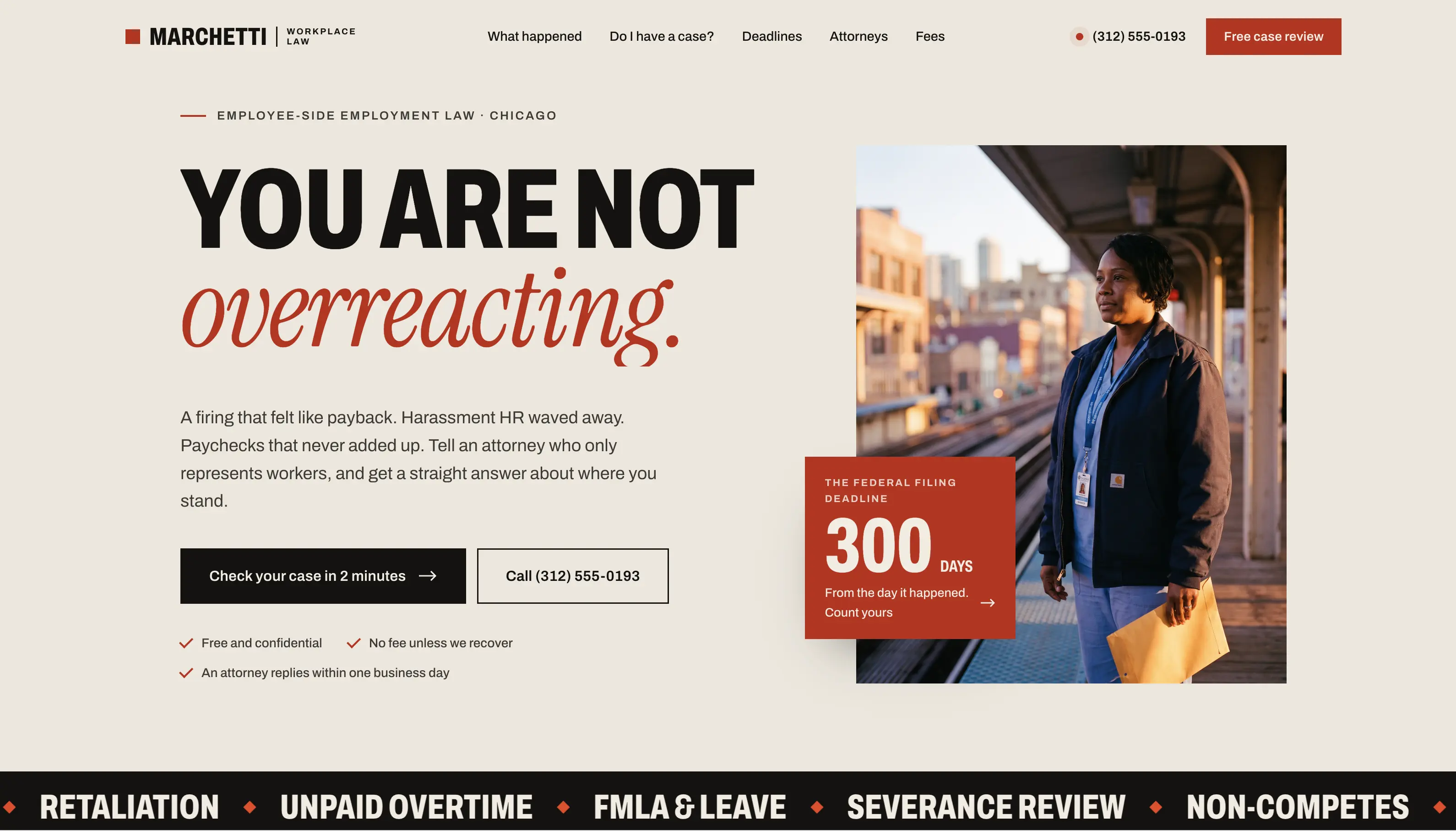
Lead with the deadline.
Filing windows for discrimination charges are short and almost no employee knows they exist. Stating them plainly converts hesitation into a call better than any persuasion copy.
Most employees have no idea an EEOC charge has a filing window. Say so clearly and you convert the visitor who was going to think about it for another month.
Employment law websites from LawFirmWebAgency are built around a visitor who is usually still employed, often researching from a work device, and working against a filing deadline they do not know exists. The site leads with deadline guidance, separates each claim type, keeps contact genuinely discreet, and adopts a different register entirely for management-side practices.
Real builds we can adapt for your firm, plaintiff-side or management-side. Open any of them to see the tone and structure.
The visitor is usually still in the job, worried about retaliation, and unaware that waiting has a legal cost.
Filing windows for discrimination charges are short and almost no employee knows they exist. Stating them plainly converts hesitation into a call better than any persuasion copy.
Many visitors are researching from a work computer or work network. Neutral page titles, a callback-at-a-safe-time option and clear confidentiality language remove a real barrier.
Wrongful termination, discrimination, harassment, retaliation, wage and hour, FMLA, whistleblower and severance review are distinct searches by people in distinct situations.
A plaintiff-side firm and a management-side firm are selling to opposite buyers. Running the same tone for both is the most common and most costly mistake in the practice area.
Every element is chosen for a visitor with something material to lose either way.
Filing windows for administrative charges and civil claims in your jurisdiction, stated in plain language near the top of the relevant pages. This is the most useful and most under-published information in the practice area.
Wrongful termination, discrimination by protected class, sexual harassment, retaliation, wage and hour and unpaid overtime, FMLA and leave, disability accommodation, whistleblower and severance agreement review.
Neutral page titles, a request-a-callback option with a safe time and number, and confidentiality stated before anything is asked. Visitors frequently browse on monitored networks and the design should assume it.
Plaintiff-side builds carry advocacy and accessible language for an individual under stress. Management-side builds carry preventive framing, compliance depth and the restraint an HR director or general counsel expects. We do not blend the two.
Employment claims turn on specific facts, so the intake captures employer size, dates, protected class and documentation status without becoming an interrogation, letting you triage before the consultation.
Whether you work on contingency, hourly or a hybrid, saying so up front filters the enquiries that were never going to convert and reassures those that will.
An employment law firm website should have one page for each type of claim, and a plaintiff firm should state the filing deadline that applies on each one. These are the pages most employment law sites need:
Why one page per matter works is covered in our guide to practice area pages that rank. Every page above is included in our law firm web design service.
Employment clients often do not know a deadline is running, which makes accurate legal information the most persuasive content on the site. Three points matter most.
The EEOC charge deadline is 180 days, extended to 300 days where a state or local agency enforces a similar law. A wrong number on the page is misleading under ABA Model Rule 7.1.
Past settlements and verdicts should carry the notice that they do not guarantee a similar outcome, and many settlements are confidential and cannot be published at all.
Visitors may be writing from a work device, and every one is owed confidentiality under Model Rule 1.18. Keep the form short and offer a safe time to call back.
The full page-by-page checklist is in our guide to attorney advertising rules for law firm websites.
This section is general information, not legal advice. Confirm current rules with your state bar.
Employment lawyer marketing is how a firm reaches workers in the days after something goes wrong at work, often before they know a deadline is running. Employment law firms get found through claim-type searches such as wrongful termination lawyer plus a city, and through questions employees ask right after something goes wrong, like whether they can be fired for reporting harassment. Answer-first claim pages that state the deadline plainly are exactly what Google and AI answers quote.
Every employment law site LawFirmWebAgency builds ships with these foundations in place. For ongoing rankings, see SEO for law firms and our guide to local SEO for lawyers.
The questions employment laws ask before they hit the “get a price” button.
An employment law website from LawFirmWebAgency is $2,995 as a fixed one-time fee, or $3,995 with brand identity included. The same price applies whether the build is plaintiff-side or management-side, though the tone and structure differ substantially between the two.
Yes, prominently, and it is the highest-converting content in the practice area. Administrative filing windows for discrimination charges are short and the overwhelming majority of employees do not know they exist. Stating the deadline that applies in your jurisdiction plainly, near the top of each relevant claim page, converts visitors who would otherwise have delayed for weeks, and is exactly the kind of factual answer that answer engines cite.
No, and attempting it is the most common mistake in the practice area. A plaintiff-side firm sells to an individual who has been wronged and needs advocacy and reassurance. A management-side firm sells to an HR director or general counsel who needs preventive compliance depth and professional restraint. The tone, the imagery, the calls to action and the content structure all differ, and a site that blends them convinces neither buyer.
Because a large proportion of visitors are still employed by the company they are considering a claim against, and many are researching from a work computer or a work network. Neutral page titles, an option to request a callback at a safe time on a personal number, and confidentiality stated before any information is requested all remove a genuine and specific barrier to first contact.
Filing deadline guidance for your jurisdiction, a separate page for each claim type, discreet contact options suited to someone still in the job, a case evaluation form that captures the facts a claim turns on, clearly stated fee terms, and a tone that matches whether you act for employees or employers.
Yes, built into every site. That means a page per claim type, jurisdiction pages, LegalService schema markup, Google Business Profile setup, and deadline and process content that ranks for the questions employees and employers actually search and gets cited by answer engines.
Same approach, tuned to each practice area — pick yours and see a landing page built just for it.
Personal injury lawyer website design
Criminal defense lawyer website design
Family law firm website design
Immigration lawyer website design
Estate planning attorney website design
Real estate attorney website design

Fixed fee. Live in seven days. Built for your side of the practice, not a blend of both.