Serve the language your clients search in.
A properly translated parallel site with correct hreflang tags, not a browser-translate widget. In most US immigration markets this is the single largest untapped source of enquiries.
A large share of your prospective clients search in Spanish, Mandarin or Portuguese, and every one of them has a reason to check that you are genuinely licensed.
Immigration websites from LawFirmWebAgency are built for an audience that frequently searches in a language other than English and has strong reason to verify that a firm is legitimate. The site ships properly translated parallel versions rather than a translate widget, a page per visa and petition type, clear process timelines, and prominent bar credentials that separate a licensed attorney from a notario.
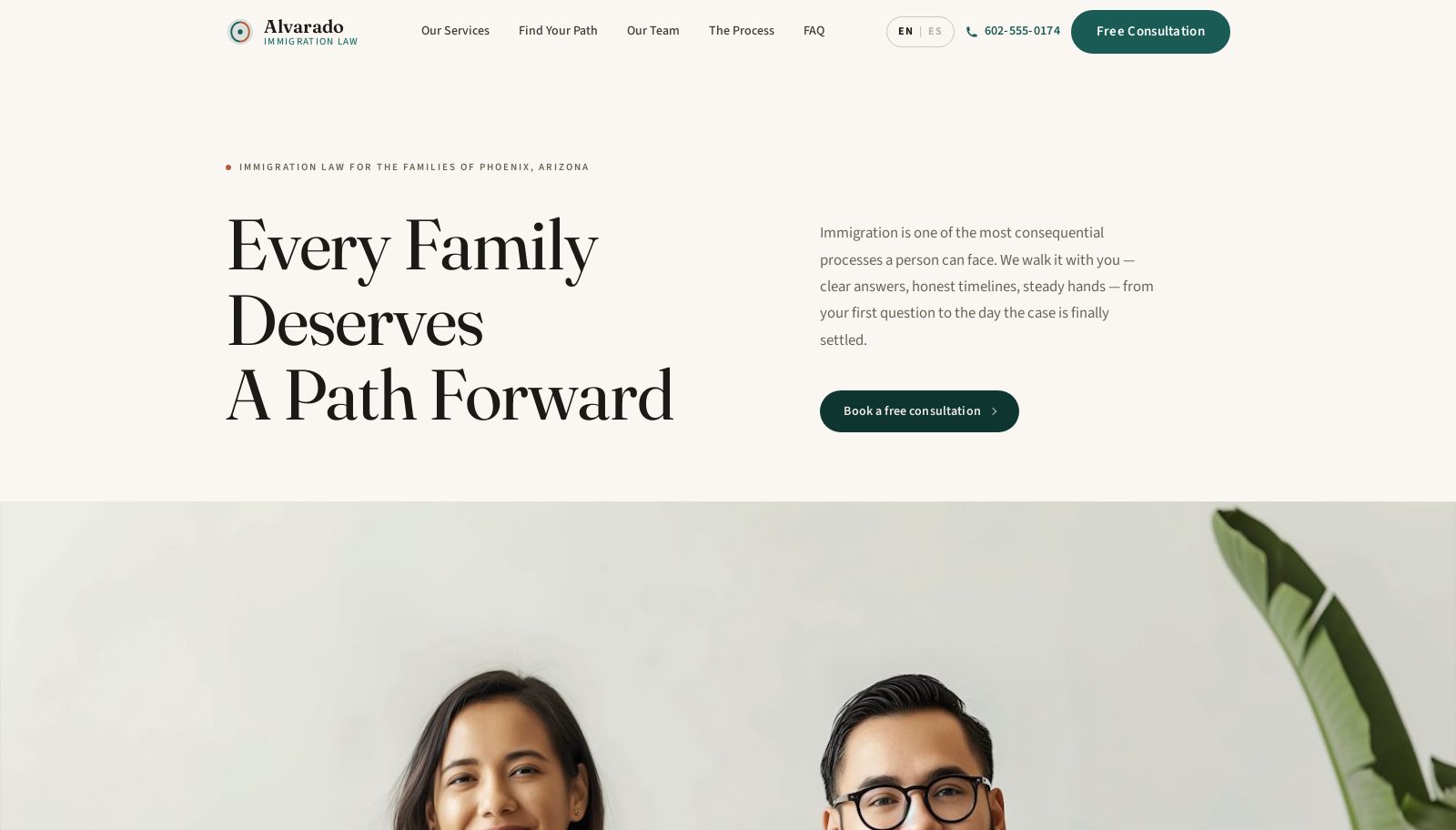
Real builds we can adapt for your firm. Open any of them to see the language switching, visa pages and credential presentation.
Immigration clients are researching a life-changing process, frequently in a second language, with well-founded caution about who they trust with it.
A properly translated parallel site with correct hreflang tags, not a browser-translate widget. In most US immigration markets this is the single largest untapped source of enquiries.
Notario fraud has made this audience justifiably cautious. Bar admissions, license numbers and AILA membership shown prominently do real conversion work.
Family-based petitions, employment visas, asylum, naturalisation, DACA, removal defense and adjustment of status are entirely different searches by people in entirely different situations.
Processing times and fee structures are what every prospect wants and few firms publish. Clear, current information on both converts better than any persuasion copy.
Every element is chosen to reduce uncertainty for someone making one of the most consequential decisions of their life.
Fully translated parallel sites with correct hreflang tags and language-appropriate URLs, so each version ranks in its own right. Human translation, because machine-translated legal content reads as untrustworthy to exactly the audience you are trying to reassure.
Family-based petitions, marriage green cards, fiancé visas, employment-based categories, H-1B, L-1, O-1, EB-5, asylum, naturalisation, DACA, TPS, adjustment of status, consular processing and removal defense.
State bar admissions with license numbers, AILA membership, and clear language distinguishing a licensed attorney from a notario or immigration consultant. This is a trust problem specific to the practice area and it deserves a specific solution.
What each process involves, realistic current timelines, and what the applicant needs to prepare. Structured so it is straightforward to update as USCIS processing times move.
Attorney fees separated clearly from government filing fees, which is a distinction most prospects do not know exists and frequently causes sticker shock later.
A contact form that does not demand immigration status before starting a conversation, with confidentiality stated plainly. Many prospects will not enter status information into a web form, and the site should not require it.
LegalService schema, Google Business Profile setup, and location pages for the specific communities your practice serves, in the languages those communities search in.
An immigration law firm website should have one page for each case type, in every language its clients search in, and a page that separates attorney fees from government filing fees. These are the pages most immigration sites need:
Why one page per matter works is covered in our guide to practice area pages that rank. Every page above is included in our law firm web design service.
Immigration clients are frequent targets of fraud, so they look hard for proof that the firm is legitimate. Three points matter most on an immigration website.
Federal rules at 8 CFR 292.1 limit who may represent people in immigration matters, mainly to attorneys and accredited representatives, so state each attorney's bar admission clearly.
In much of Latin America a notario is a lawyer, while in the U.S. a notary public is not, and several states restrict the term in advertising. Never use it in a way that blurs that line.
Every language version must say the same thing as the English page, disclaimers included, because ABA Model Rule 7.1 applies to each one.
The full page-by-page checklist is in our guide to attorney advertising rules for law firm websites.
This section is general information, not legal advice. Confirm current rules with your state bar.
Immigration law firm marketing is how a firm reaches clients and families who search in more than one language and check credentials carefully. Immigration firms get found through case-type searches in more than one language, often from outside the firm's city, and through questions about processing times and eligibility. Properly translated parallel pages with correct hreflang tags, rather than a translation widget, reach the clients who search in Spanish and other languages.
Every immigration site LawFirmWebAgency builds ships with these foundations in place. For ongoing rankings, see SEO for law firms and our guide to local SEO for lawyers.
The questions immigrations ask before they hit the “get a price” button.
An immigration website from LawFirmWebAgency is $2,995 as a fixed one-time fee, or $3,995 with brand identity included. Additional fully translated language versions are quoted separately since they require human translation rather than automated conversion.
In most US markets, yes, and it is usually the highest-return single addition to the site. A large share of immigration prospects search in Spanish, and a properly translated parallel site with its own URLs and hreflang tags ranks independently in Spanish-language search. A browser-translate widget does not, and reads as untrustworthy to the audience it is meant to serve.
Because notario fraud is a widespread and well-documented problem. In many Latin American countries a notario público is a qualified legal professional, while in the United States a notary public is not, and unlicensed consultants have exploited that confusion for decades. Prospective clients have often been warned to verify licensing, so bar admissions, license numbers and AILA membership displayed prominently do measurable conversion work.
A separate page for each visa and petition type you handle, fully translated versions in the languages your community searches in, prominent bar credentials and AILA membership, current process timelines, a clear separation of attorney fees from government filing fees, and a contact option that does not require someone to disclose immigration status before speaking to you.
Yes. A family-based green card petition, an H-1B transfer and a removal defense matter are completely different situations searched with completely different terms by people with different urgency and different budgets. Separate pages let each rank on its own and let the content address one process properly, including its actual timeline and requirements.
Timeline content is built as structured, easily editable data rather than baked into page copy, so updating it as USCIS processing times move is a quick edit rather than a redesign. We also advise dating the information visibly, which both manages expectations and signals to answer engines that the page is actively maintained.
You can, but it will cost you enquiries. Many prospects will not enter status information into a web form, particularly on a shared device, and requiring it filters out people who would have become clients. We build forms that ask only what is needed to open a conversation and leave status questions for the consultation itself.
Yes, built into every site. That means a page per visa and petition type, location pages for the communities you serve, LegalService schema markup, correct hreflang implementation across language versions, and process content that ranks for the questions prospects actually search and gets cited by answer engines.
Same approach, tuned to each practice area — pick yours and see a landing page built just for it.
Personal injury lawyer website design
Criminal defense lawyer website design
Family law firm website design
Estate planning attorney website design
Employment lawyer website design
Real estate attorney website design

Fixed fee. Live in seven days. Built for a multilingual, credential-checking audience.