Split the planning and probate journeys.
A 58-year-old organizing a trust and a grieving executor facing a court deadline need different entry points, different tone and different calls to action. Merging them serves neither.
One is planning calmly for the future. The other lost a parent last week and needs probate help today. The same page cannot serve both well.
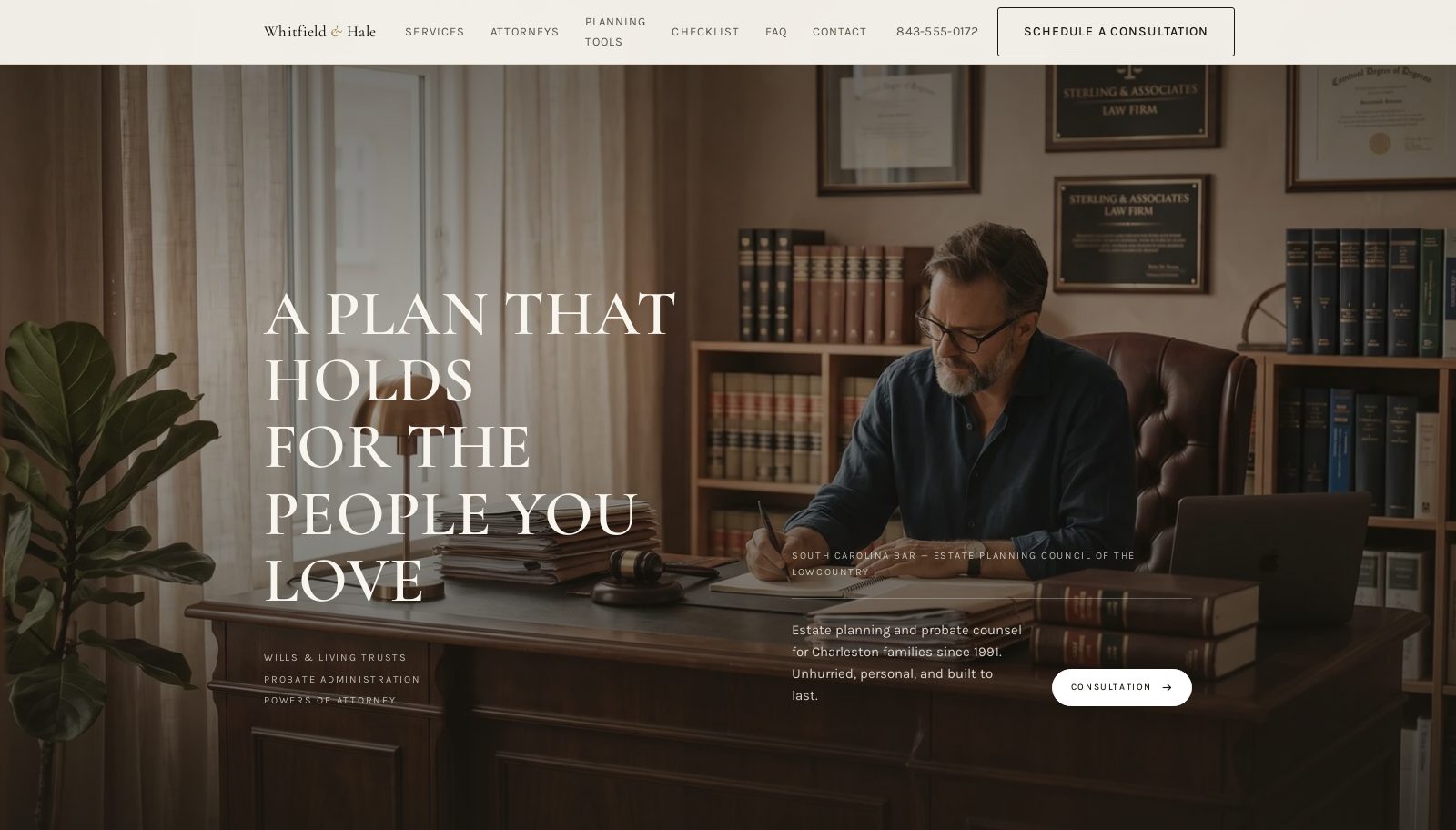
Estate planning websites from LawFirmWebAgency are built for two visitors with opposite mindsets: someone calmly planning ahead, and someone who has just lost a family member and needs probate help now. The site separates those journeys, meets accessibility standards for an older audience properly rather than nominally, and supports the seminar and guide funnels the practice area runs on.
Real builds we can adapt for your firm. Open any of them to see the split journeys, the accessibility work and the seminar funnels.
This practice area serves the calmest and the most distressed clients in consumer legal work, often on the same website, and usually on the same day.
A 58-year-old organizing a trust and a grieving executor facing a court deadline need different entry points, different tone and different calls to action. Merging them serves neither.
The core demographic is over 55. Genuinely readable type, real contrast, generous tap targets and full keyboard navigation are not compliance box-ticking here, they directly determine whether someone can use the site.
Estate planning runs on workshops, downloadable guides and educational content more than any other practice area. The site has to make registration and download effortless and capture the contact properly.
Clients are choosing someone to hold documents that matter decades from now. Firm history, credentials and succession planning are genuine conversion factors, not vanity content.
Every element is chosen to serve two audiences whose needs barely overlap.
Planning ahead and dealing with a death get distinct routes from the homepage, with different tone, different urgency and different first steps. The probate route leads with deadlines and immediate help, the planning route with education.
Wills, revocable and irrevocable trusts, powers of attorney, healthcare directives, guardianship nominations, special needs trusts, asset protection, business succession, probate administration, trust administration and estate litigation.
Base type at a genuinely readable size, contrast comfortably beyond WCAG AA, large tap targets, full keyboard navigation and correct screen reader semantics. For an audience largely over 55, this is the difference between a usable site and an abandoned one.
Workshop scheduling with straightforward registration, and gated guides that capture a contact without demanding a ten-field form. This funnel is how most estate planning firms actually fill their calendar.
Clear, jurisdiction-specific information on what an executor must do and by when. It is genuinely useful, it ranks well, and it reaches someone at the exact moment they need to instruct a firm.
Firm history, attorney credentials, and what happens to documents held over decades. Clients are making a long-horizon decision and this is the content that answers the unspoken question.
Flat fees for planning packages, and how probate fees work in your jurisdiction, including whether they are set by statute. Clarity here removes the main hesitation before booking.
An estate planning law firm website should have separate paths for people planning ahead and families handling a death, with a page for each service on both. These are the pages most estate planning sites need:
Why one page per matter works is covered in our guide to practice area pages that rank. Every page above is included in our law firm web design service.
Estate planning marketing leans on seminars, guides and promises about avoiding probate. Three rules keep that marketing on the right side of the bar.
Copy that says a trust always avoids probate or eliminates estate tax can mislead under ABA Model Rule 7.1. Explain when it does and when it does not.
Some states certify estate planning or probate specialists, and Model Rule 7.2(c) allows the specialist title only with that certification, naming the organization.
Inviting people to a free seminar is advertising, but live follow-up with attendees who did not ask for it can fall under the solicitation limits of Model Rule 7.3.
The full page-by-page checklist is in our guide to attorney advertising rules for law firm websites.
This section is general information, not legal advice. Confirm current rules with your state bar.
Estate planning marketing is how a firm reaches two audiences: people planning ahead and families dealing with a death. Estate planning firms get found through cost and comparison questions, such as how much a will costs or whether a trust is better than a will, and through probate lawyer searches with a county name after a death. Clear guides that answer those questions, linked to service pages with a simple booking form, turn research into consultations.
Every estate planning site LawFirmWebAgency builds ships with these foundations in place. For ongoing rankings, see SEO for law firms and our guide to local SEO for lawyers.
The questions estate plannings ask before they hit the “get a price” button.
An estate planning website from LawFirmWebAgency is $2,995 as a fixed one-time fee, or $3,995 with brand identity included. That covers both the planning and probate sides of the practice, seminar registration and guide download funnels, and the accessibility work the audience requires.
On the same site, yes, but on clearly separated paths. Someone planning their estate and someone administering a deceased parent's estate arrive in completely different states of mind with completely different urgency. A single merged services page forces both to work out which half applies to them, and loses the probate enquiry in particular, since that visitor is usually working to a court deadline.
Because the core audience is largely over 55, and a meaningful proportion have some degree of vision impairment. Small light-grey text, low contrast and tiny tap targets are common in modern web design and effectively exclude this demographic. Larger base type, contrast beyond the WCAG AA minimum, generous tap targets and proper keyboard navigation directly increase the number of people who can complete an enquiry.
Separated planning and probate journeys, a page for each instrument you draft, plainly stated flat fees for planning packages, seminar registration and downloadable guides, probate deadline guidance for your jurisdiction, firm history and succession information, and accessibility built for an older audience rather than retrofitted.
Yes, they remain one of the most reliable client sources in the practice area, and the website is usually the constraint rather than the seminar itself. Registration forms asking for ten or more fields, no confirmation sequence and no reminder emails lose a large share of people who intended to attend. Reducing registration to a few fields with a proper reminder sequence typically produces a substantial increase in attendance.
Plainly, and with the structure explained. In some jurisdictions probate fees are set by statute as a percentage of the estate, which prospective clients almost never know. Explaining how fees are calculated where you practise, and what drives them up or down, removes the main hesitation before someone calls, and is a question answer engines are frequently asked to resolve.
Warm, plain and unhurried on the planning side, and direct and practical on the probate side. Avoid euphemism, since someone dealing with a death is served better by clear language than by delicate phrasing, and avoid urgency tactics entirely on the planning side, because pressure is exactly the wrong signal for a decision about permanence.
Yes, built into every site. That means a page per instrument and per service, jurisdiction pages for the counties you serve, LegalService schema markup, Google Business Profile setup, and educational content on probate deadlines and trust structures that ranks and gets cited by answer engines.
Same approach, tuned to each practice area — pick yours and see a landing page built just for it.

Fixed fee. Live in seven days. Built for planners and for the recently bereaved.