Web Design9 min read
Web Design for Family Lawyers: Building a Site Divorce and Custody Clients Trust
Family law clients research slowly, privately and often on a phone someone else can see. Here is how to design a family law website for them: the pages, the tone, the safety features and the intake that earn the first call.

On this page
- What makes web design for family lawyers different?
- What pages should a family law firm website have?
- How should a family law website look and sound?
- What safety and privacy features does a family law website need?
- How should intake work on a family law website?
- Should a family law firm publish its fees on its website?
- How do family law websites get found on Google and in AI answers?
- What advertising rules apply to a family law website?
- How much does a family law website cost?
- Family law website checklist
- How LawFirmWebAgency builds family law websites
- Sources
Key takeaways
- Family law clients research slowly and privately, so depth and trust matter more than urgency on the website.
- Give every matter its own page, and add process, fee, county and attorney bio pages.
- Add a quick-exit button, a private browsing note and a safe-contact option to intake.
- Keep the intake form short and ask for the other party's name so the firm can run a conflict check before any details are shared.
- Avoid outcome promises, contingency fee language for divorce and specialist claims you are not certified to make.
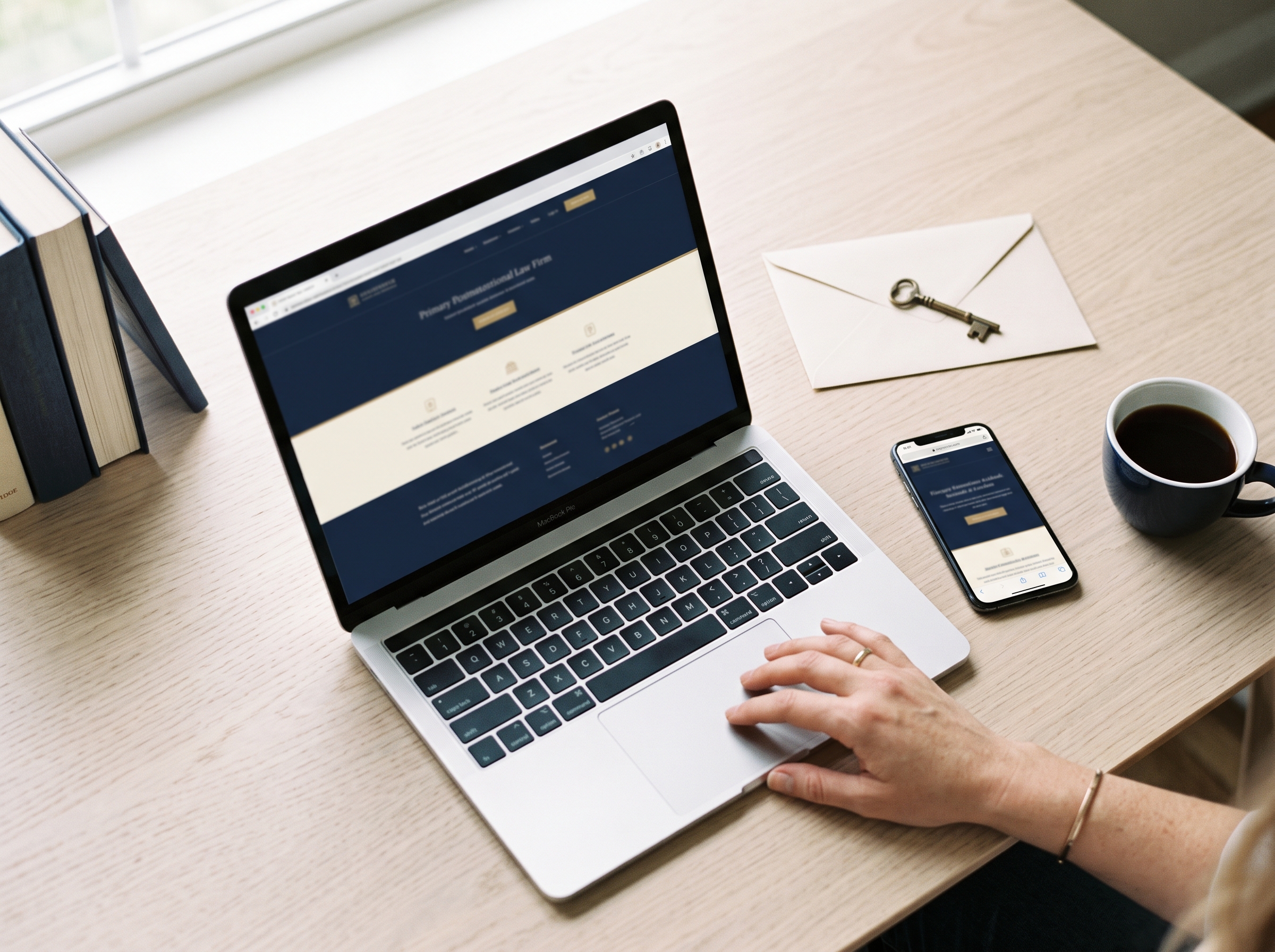
Short answer: Web design for family lawyers means building a website around how people actually choose a divorce or custody attorney: slowly, privately and under strain, often on a phone someone else can pick up. A good family law website gives every matter its own page, explains the process and the fees in plain language, introduces the attorneys as people, keeps the design calm, offers a quick-exit button and a discreet intake form, and is set up to be found by county. Every page must also follow your state's attorney advertising rules.
What makes web design for family lawyers different?
Web design for family lawyers is different because the visitor is different. Someone who needs a personal injury or criminal defense lawyer usually needs help today. Someone thinking about divorce, custody or a protective order often reads for weeks before making contact, comes back to the same websites several times and compares how each firm makes them feel. Four things follow from that.
- Depth beats urgency. Process guides, honest fee information and real attorney bios do more work than flashing banners and countdown offers.
- Privacy is a design requirement. The visitor may share a phone, a laptop or an email account with the person they are thinking of leaving.
- Tone signals how you practice. A site that talks about fighting and winning tells a parent who hopes for a civil co-parenting plan that you are the wrong firm.
- More than one side reads it. The other spouse and their lawyer can read your site too, so every claim needs to hold up.
| Element | Typical law firm website | Family law website |
|---|---|---|
| Main goal | Get the call now | Earn trust across several visits |
| Tone | Confident, sometimes aggressive | Calm, plain and steady |
| Key pages | Practice areas and results | One page per matter, process guides, fees and county pages |
| Contact | Call now for a free case review | Confidential form, a safe time to call, a no-obligation consultation |
| Safety | Rarely considered | Quick-exit button and private browsing guidance |
| Imagery | Gavels, skylines and handshakes | Real attorneys and warm, ordinary scenes |

What pages should a family law firm website have?
A family law firm website should have a separate page for each kind of matter the firm takes, because each one is a separate search by a person in a different situation. Most family law websites need these practice pages:
- Divorce, with contested and uncontested divorce explained separately
- Child custody and parenting time
- Child support
- Spousal support (alimony)
- Property and debt division
- Prenuptial and postnuptial agreements
- Adoption
- Protective orders
- Modifications of existing orders
- Mediation and collaborative divorce
Then add the supporting pages that answer the questions people have before they call:
- A process page that walks through a divorce in your state from filing to final judgment, with realistic timelines.
- A fees page that explains how you charge, what a retainer is and what makes a case cost more or less.
- County or courthouse pages for each place you regularly appear, written with real local detail rather than swapped city names.
- Attorney bios with real photos, bar admissions, the matters each lawyer handles and how they work with clients.
- A first consultation page that says what happens, how long it takes, what to bring and whether it is free.
Our guide to practice area pages that rank shows how to structure each of these pages so it can stand on its own in search.
How should a family law website look and sound?
A family law website should look calm and sound like a steady, experienced person explaining what happens next. These design choices get you there:
- Restrained color and generous white space. A quiet palette with one accent color reads as composed. Bright red buttons and urgent banners read as pressure.
- Readable type. Body text large enough to read on a phone without zooming, short paragraphs and clear headings, because many visitors read late at night and tired.
- Real, warm photography. Your attorneys, your office and ordinary family scenes in natural light. Skip broken wedding rings, crying children, torn photographs and gavels; they add distress, not trust.
- Headlines that name the matter and the place. "Divorce and custody lawyers in Maricopa County" tells a visitor they are in the right place. "Aggressive advocates who fight to win" tells a worried parent the opposite of what they want to hear.
- The words clients use. Use terms like parenting time and child support the way your state's courts and your clients do, and explain legal terms the first time they appear.
Keep the same tone in the small print: button labels, form messages and confirmation emails. "Request a confidential consultation" sets a very different expectation from "Get started now".
What safety and privacy features does a family law website need?
A family law website needs a quick-exit button, a short note about private browsing and an intake process that never puts a visitor at risk. Some visitors are researching while living with an abusive partner, and any firm that handles protective orders or contested custody should design for them.
- A quick-exit button. A clearly labeled button, fixed on screen, that immediately replaces your page with a neutral site such as a weather or news page. The National Domestic Violence Hotline's own website lets visitors leave by clicking an X or pressing the Escape key twice, and a keyboard shortcut like that is worth copying.
- A replaced page, not a new tab. The button should replace the current page in the browser history, so pressing Back does not bring your site straight back.
- A private browsing note. Explain in a sentence or two that browsing history cannot always be fully erased, and that a private window or a safer device, such as one at a library or workplace, offers more protection. The Hotline gives the same advice.
- A safe way to reach them. Let visitors choose phone, text or email and a safe time, and add a checkbox for "Please do not leave a voicemail".
- Discreet messages. Confirmation emails and texts should have neutral subject lines and should not repeat what the visitor wrote.
- Care with advertising trackers. Retargeting ads can follow a visitor to other websites on a shared device. Consider leaving them off sensitive pages such as protective orders.
If you handle protective orders, also show the National Domestic Violence Hotline number, 1-800-799-7233, and 911 for anyone in immediate danger. These features cost little to build and tell every visitor that your firm understands who is reading.
How should intake work on a family law website?
Intake on a family law website should collect only what the firm needs to run a conflict check and call back, because family law is the practice area where the other side is most likely to contact the same firm. Under ABA Model Rule 1.18, a lawyer who receives information from a prospective client that could be significantly harmful to that person can be barred from representing the other side in the same matter. A detailed form from one spouse can stop you from taking the other spouse's case.
A good family law intake form asks for five things:
- Name and the best way to reach them
- A safe time to call, and whether a voicemail is okay
- The type of matter: divorce, custody, support, a protective order and so on
- The county where the case is or would be filed
- The other party's full name, for the conflict check
Next to the submit button, add a short notice that sending the form does not make the visitor a client and that they should not share details of their situation until the firm confirms it can help. ABA Formal Opinion 10-457 explains why that notice matters on law firm websites. After the form is sent, say what happens next and when someone will reply.
Should a family law firm publish its fees on its website?
A family law firm should explain its fees on its website, even if it only gives ranges. How much a divorce costs is one of the first things people want to know, and a firm that answers plainly helps visitors decide before the first call. Explain:
- Whether you bill hourly, charge flat fees for some matters, such as uncontested divorces or prenuptial agreements, or both
- What a retainer is, how it is held and what happens to any unused part
- What makes a case cost more, such as custody disputes, complex assets, expert witnesses or a trial
- Whether the first consultation is free and how long it lasts
Use ranges you can stand behind, and never suggest a contingency fee for a divorce: ABA Model Rule 1.5(d) prohibits fees that depend on securing a divorce or on the amount of support or a property settlement.
How do family law websites get found on Google and in AI answers?
Family law websites get found when they answer the questions people search before they call, on pages tied to a specific place. Family law research often starts with a question, such as how custody works in Ohio or how long a divorce takes, and ends with a local search, such as a divorce lawyer plus a county name. Build for both:
- Question-led guides that answer in the first sentence and then explain your state's process. Google AI Overviews, ChatGPT and Perplexity quote answers that make sense on their own.
- A page per county or court you serve, with local detail such as the courthouse, local mediation programs and filing steps.
- A complete Google Business Profile that uses the same firm name, address and phone number as the website.
- Structured data: LegalService markup for the firm, Person markup for each attorney and FAQPage markup where a page shows visible questions and answers.
- Reviews, handled carefully. Family law clients are often reluctant to post public reviews, and a reply must never reveal anything about a client's matter. ABA Formal Opinion 496 covers how lawyers may respond to negative online reviews.
Our guides to local SEO for lawyers and getting cited in AI Overviews and ChatGPT go deeper on each step.
What advertising rules apply to a family law website?
Every page of a family law website is attorney advertising, so your state's version of the ABA Model Rules applies. Four rules come up most often:
- No misleading claims (Model Rule 7.1). Avoid promising custody, a quick divorce or protected assets. Describe the process and your approach instead.
- Certified specialist is a protected title (Model Rule 7.2(c)). Only lawyers certified by an approved organization may claim it. Some states, including California, Texas and Florida, certify family law specialists.
- No contingent fees in divorce (Model Rule 1.5(d)). Fees that depend on securing a divorce or on the amount of support or a property settlement are prohibited.
- Name the responsible lawyer (Model Rule 7.2(d)). Advertising must include the name and contact information of at least one lawyer or law firm responsible for its content.
States add their own requirements on testimonials, past results and disclaimers. Our attorney advertising rules checklist covers them.
How much does a family law website cost?
A family law website costs from about $1,000 to $5,000 or more with a freelance designer and $5,000 to $20,000 or more with a full-service agency, according to the American Bar Association's Law Technology Today. LawFirmWebAgency builds family law websites for a fixed $2,995, or $3,995 with brand identity, with no monthly retainer, and your firm owns the site, the code and the domain. The full breakdown is in our law firm website cost guide.
Family law website checklist
Use this checklist to review your current website or to brief a designer:
- A separate page for each matter you handle
- A plain-language guide to the divorce process in your state
- Fee information with ranges and the factors that change them
- Attorney bios with real photos and a human voice
- A page for each county or court you regularly appear in
- Calm design: restrained color, readable type and real photography
- A quick-exit button and a private browsing note
- A short intake form with the other party's name, a safe-contact option and a confidentiality notice
- Tap-to-call and fast pages on phones
- Copy reviewed by an attorney against your state's advertising rules
- A Google Business Profile that matches the website
- Call and form tracking, so you know which pages bring consultations
How LawFirmWebAgency builds family law websites
LawFirmWebAgency designs websites only for U.S. law firms. Every family law firm website design project includes a page per matter, process and fee guidance, a working quick-exit control, discreet intake, county pages and local SEO setup, for a fixed $2,995, typically live 7 days after kickoff. Open the Thornbury Family Law demo on your phone to see the tone and the quick-exit button in action, or read about our law firm web design service.
Keep reading: most family law clients search from a phone, so see law firm mobile website design. For the copy on each page, read law firm website content, and for the general buyer's guide, web design for lawyers.
This article is general information, not legal advice. Confirm current rules with your state bar.
Sources
- American Bar Association: Model Rules of Professional Conduct
- American Bar Association, Law Technology Today: Attorney Website Costs, Budgeting and Maximizing ROI (2024)
- The National Domestic Violence Hotline: Internet Safety for Survivors
- Google Search Central: Creating helpful, reliable, people-first content
- Google Business Profile Help: Guidelines for representing your business on Google
This article is general information for law firms about websites and marketing. It is not legal advice, and LawFirmWebAgency is not a law firm. Check your state bar's current rules before you publish any advertising.